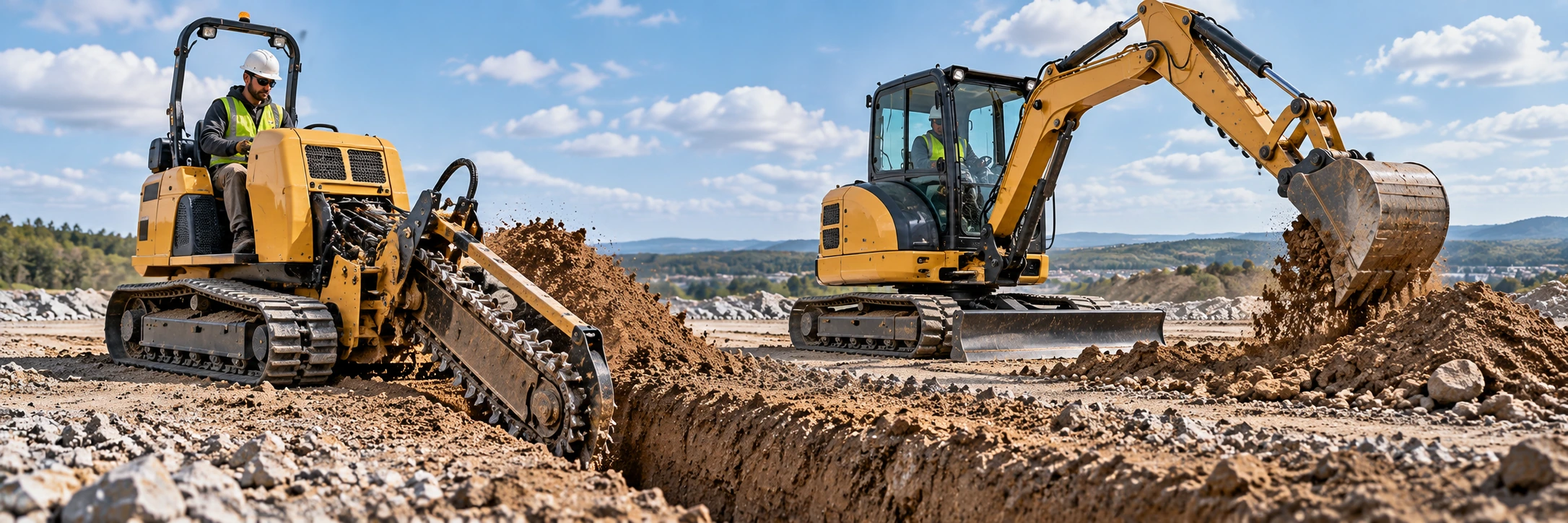
A trencher and a mini excavator can both open ground for utilities, drainage and site work, but they do not solve the job in the same way. A trencher is a specialized machine built to cut a relatively consistent trench. A mini excavator trades some of that specialization for digging flexibility, spoil handling and the ability to perform many other tasks. The right choice starts with trench length, width, depth, soil and what else the crew needs the machine to do.
1. Define the trench before choosing equipment
Record required width and depth, total linear footage, soil type, rock content, slope, access width, known utility conflicts and restoration requirements. A long uniform run through workable soil is a different problem from short irregular excavation around existing structures.
2. Trenchers are purpose-built for continuous trenching
Vermeer offers walk-behind and ride-on trenchers for utility installation and other narrow-trench work, with different boom, chain and attachment options for ground conditions. That specialization can make a trencher productive when the job needs repeated, consistent trench geometry.
3. Mini excavators are built around versatility
A compact excavator can dig, bench, shape, load spoil and work with buckets, breakers, augers and other tools. Caterpillar positions mini excavators for construction and utility work where compact size and multiple attachments matter. That versatility can reduce the need for a second machine on smaller mixed-scope jobs.
4. Long, uniform runs often favor specialization
When the route is open and the trench specification is consistent, a trencher can create a repeatable cut without the bucket-by-bucket cycle of an excavator. Production still depends on chain or wheel selection, soil, depth, operator technique and spoil handling.
5. Irregular excavation often favors the excavator
Mini excavators can widen sections, dig pits, shape around structures, load removed material and change depth frequently. They may be a stronger fit where the work includes more than a simple continuous trench. Existing utilities should always be located and handled according to applicable safety requirements before excavation begins.
6. Spoil and restoration matter
A trencher typically creates a narrower spoil stream along the cut, while an excavator can place, separate or load spoil more deliberately. Consider how material will be reused, removed and compacted after installation. A narrower trench can reduce restoration volume, but only when it still meets the job specification.
7. Access and transport can decide the job
| Question | Trencher | Mini excavator |
|---|---|---|
| Primary strength | Continuous narrow trenching | Flexible excavation and material handling |
| Trench geometry | Consistent width and path | Easy to vary width, depth and shape |
| Other tasks | Depends on attachments and model | Broad attachment and digging capability |
| Site fit | Excellent when route suits machine geometry | Strong where work is irregular or mixed |
8. Attachments can blur the line
Some compact loaders and excavators can run trenching attachments, while ride-on trenchers can accept plows or other tools. Confirm hydraulic flow, attachment compatibility, digging specification and machine stability before assuming one machine can replace a purpose-built unit.
9. Inspect used machines differently
On a used trencher, focus on chain or wheel wear, boom, sprockets, rollers, drive components, hydraulics, tracks or tires and controls. On a mini excavator, add undercarriage, swing system, boom and stick, pins, bushings and bucket linkage to the inspection.
The takeaway
Choose a trencher when the job is dominated by long, consistent trenching and the ground suits the cutting system. Choose a mini excavator when excavation is irregular, spoil handling matters or the machine must perform several different tasks during the project.
Related BigEquipCo guides: Used Trencher Buying Guide, Used Mini Excavator Buying Guide and Heavy Equipment Attachment Compatibility.