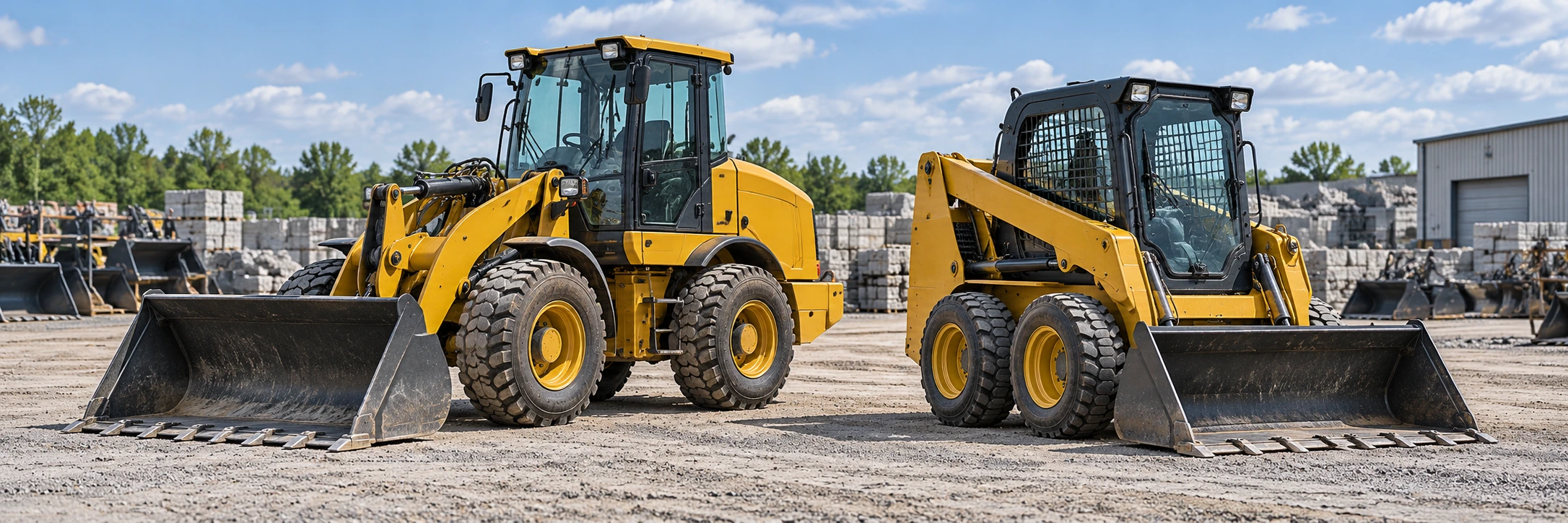
Compact wheel loaders and skid steers overlap in many loading, material-handling and attachment jobs, but they achieve that work with very different chassis layouts. The best choice depends less on machine size alone and more on turning style, travel distance, surface conditions, lift requirements and the attachments you plan to run.
Caterpillar and CASE both position compact wheel loaders around maneuverability, lifting and attachment versatility, while skid steers emphasize compact dimensions, tight turning and a broad attachment ecosystem. Compare the machines around your actual duty cycle.
Compact wheel loader vs. skid steer at a glance
| Factor | Compact wheel loader | Skid steer |
|---|---|---|
| Turning | Articulated steering | Skid steering / counter-rotation |
| Travel | Often better suited to repeated travel | Strong in compact work zones |
| Surface disturbance | Typically less tire scrubbing in turns | Can scrub tires and finished surfaces |
| Operator position | Higher seating on many models | Compact cab between lift arms |
| Attachments | Strong loader and tool-carrier role | Very broad attachment ecosystem |
1. Compare the way each machine turns
A compact wheel loader articulates at the center joint. A skid steer changes direction by varying wheel speed from side to side. Skid steering can be extremely effective in tight spaces, but it also creates tire scrub on hard surfaces.
2. Consider travel distance
If the machine repeatedly carries material across a larger yard or site, travel speed, ride and tire wear matter. Compact wheel loaders are often attractive for load-and-carry cycles. A skid steer can still be the better choice where travel is short and turning room is limited.
3. Compare lift geometry and load requirements
Do not compare machines by horsepower alone. Review rated operating capacity, tipping load, bucket capacity, hinge-pin height, dump clearance and reach at full height. Match those specifications to truck sideboards, hoppers, pallets and material density.
4. Think about ground conditions
On pavement, yards and finished surfaces, articulated steering can reduce tire scrubbing. On rough construction work, the skid steer’s compact footprint may be more valuable. If soft-ground flotation is the main issue, also compare a compact track loader rather than assuming either wheeled machine is ideal.
5. Compare attachment needs
Skid steers are widely used with augers, trenchers, brooms, cold planers, grapples and hydraulic tools. Compact wheel loaders can also use quick-coupler attachments, but hydraulic flow, coupler interface and machine balance must match the intended tool.
6. Evaluate visibility and access
Compare sightlines to the bucket edge, forks, rear of machine and jobsite traffic. Also consider how frequently the operator enters and exits. Cab position and access can materially affect productivity in repetitive work.
7. Compare ownership wear
Look beyond purchase price. Tire wear, articulation-joint maintenance, hydraulic attachment demand and travel cycles all affect operating cost. A machine that is slightly larger but better matched to the duty cycle can be less expensive to own than one constantly working at its limit.
Which machine fits best?
Choose a compact wheel loader when load-and-carry work, repeated travel, articulated steering and loader-style visibility are priorities. Choose a skid steer when tight maneuvering, compact dimensions and attachment versatility dominate the job.
The takeaway
The right comparison is job cycle versus machine geometry. Measure the loads, travel distance, clearances, surfaces and attachments before choosing either platform.
Related BigEquipCo guides: Used Wheel Loader Buying Guide and Skid Steer vs. Compact Track Loader.