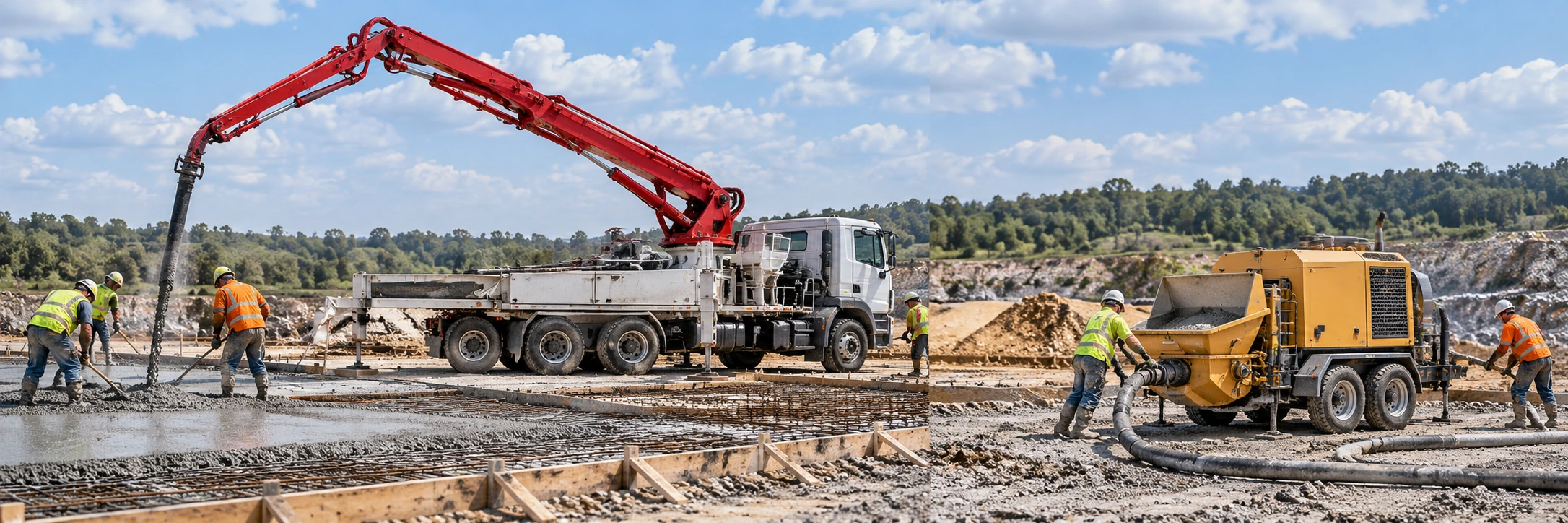
Boom pumps and line pumps move concrete through pipe or hose, but they solve different placement problems. A boom pump carries an articulated placing boom. A line pump sends concrete through ground-laid or manually positioned delivery line.
Choose based on placement, not just pump size
The most important questions are where the truck can set up, how far and high the concrete must travel, how much material must be placed, how often the pour location moves and how much hose handling the crew can support.
When a boom pump has the advantage
A boom pump can place concrete over obstacles, onto elevated decks and across large slabs without manually dragging the full delivery line as the placement point changes. It is especially useful when vertical or horizontal reach is the primary challenge.
When a line pump has the advantage
Line pumps can work well on pours where the placement route can be reached with hose or pipe and where a large boom truck cannot set up. ACPA describes line-pump systems that use two- to three-inch delivery systems and may be trailer-, truck- or skid-mounted.
Setup space and site access
Boom pumps need room for the truck, outriggers and safe boom movement. Line pumps may fit tighter sites, but the crew needs a safe route for delivery hose and enough room to manage bends, clamps and line movement.
Reach and obstructions
A boom can reach over structures, excavation edges and other obstacles. A line can route around obstacles but adds hose length, bends and handling. The concrete mix, line diameter and pumping distance all matter.
Production rate is application-specific
Do not compare only a brochure's maximum output. Actual production depends on concrete mix, line configuration, vertical rise, hose diameter, pump condition, placing pace and ready-mix delivery.
Safety and operator qualification
ACPA treats boom pumps and line pumps as distinct certification categories. Boom work adds overhead power-line and outrigger hazards; line work adds hose, coupling and high-pressure line hazards. Equipment type should match trained personnel and jobsite controls.
| Job characteristic | Likely advantage |
|---|---|
| Elevated deck or vertical reach | Boom pump |
| Reach over obstacles | Boom pump |
| Large placement area that moves often | Boom pump |
| Tight truck access | Line pump |
| Smaller flatwork or short placement route | Line pump |
| Trailer or compact pump requirement | Line pump |
The takeaway
Match the pump to the placement geometry and jobsite. Reach, access, line routing, setup footprint, crew requirements and operator qualification are more useful decision points than simply choosing the larger machine.
Related BigEquipCo guides: Heavy Equipment Shipping Guide and Heavy Equipment Total Cost of Ownership.