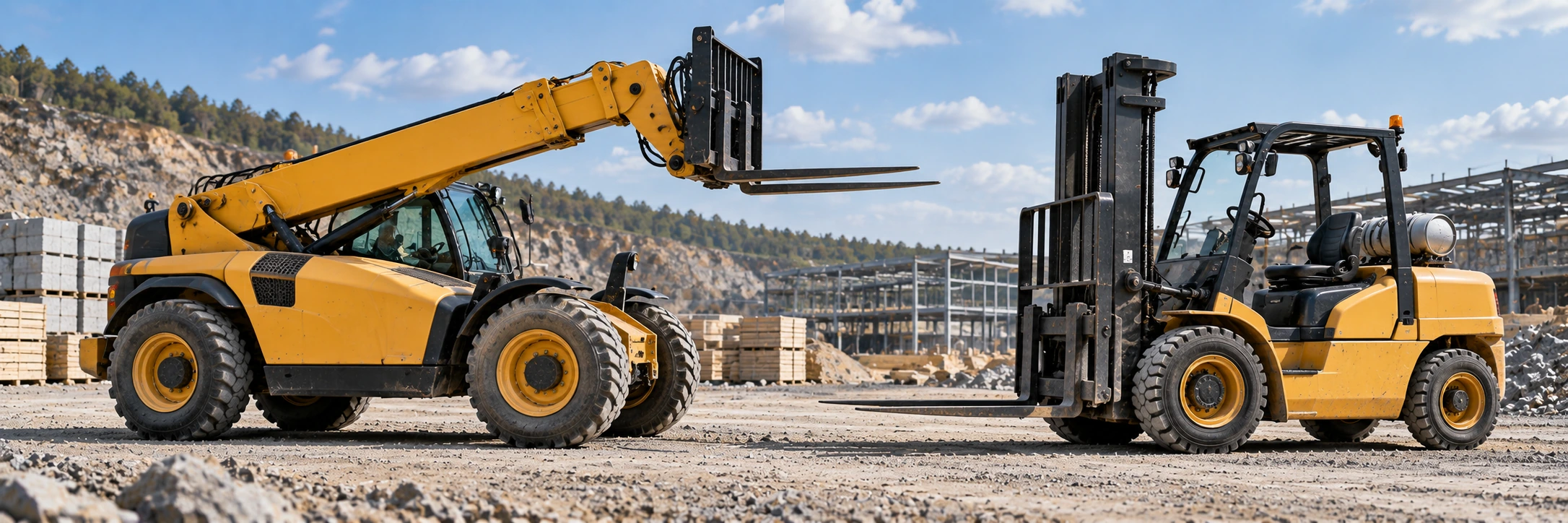
Telehandlers and forklifts can both move palletized material, but the machines are designed around different environments. A conventional forklift centers the load on a vertical mast close to the chassis. A telehandler uses a telescoping boom that can lift upward and reach forward, which changes both what the machine can do and how capacity must be evaluated.
OSHA separates powered industrial truck standards by truck type and recognizes rough-terrain industrial trucks used on unimproved construction terrain. JLG and Genie likewise describe the telehandler around boom reach and construction-oriented material placement.
Telehandler vs. forklift at a glance
| Factor | Telehandler | Conventional forklift |
|---|---|---|
| Lift mechanism | Telescoping boom | Vertical mast |
| Forward reach | Major capability | Limited |
| Typical terrain | Construction and rough terrain | Improved yards and indoor floors |
| Capacity evaluation | Changes with boom angle and extension | Based on truck/load configuration and load center |
| Attachments | Forks plus approved boom attachments | Forks plus approved industrial-truck attachments |
1. Start with where the machine will work
Warehouses, plants and smooth yards often favor the compact turning and vertical mast of a forklift. Construction sites, framing work and uneven outdoor terrain often favor a rough-terrain telehandler designed for ground clearance and site travel.
2. Decide whether you need forward reach
A telehandler can place material over obstacles or into elevated work areas because the boom extends outward. That ability is one of its biggest advantages, but it also means capacity changes as the load moves farther from the machine.
3. Understand load charts
Never assume the headline maximum capacity applies at full reach or full height. Telehandler operators use the machine-specific load chart for boom angle, extension, attachment and load. Forklift capacity also depends on configuration and load center, so the data plate must match the truck and attachment in use.
4. Compare maneuverability and space
A warehouse forklift can be extremely efficient in aisles designed around its turning radius. A telehandler is generally larger and needs more room, but many models offer steering modes that help on construction sites.
5. Compare tires and terrain
Rough-terrain telehandlers typically use large tires and chassis designed for unimproved surfaces. Industrial forklifts are commonly optimized for improved floors or yards. Match tire type, traction and ground clearance to the real surface rather than the job title.
6. Compare attachments carefully
Both machine types can use attachments, but attachment approval, capacity and hydraulic requirements matter. Confirm the attachment is intended for the exact machine and reflected in the applicable load information.
7. Evaluate operator requirements and site rules
Training and safe-use requirements depend on the machine, application and jurisdiction. Use current manufacturer instructions and applicable OSHA rules rather than assuming experience on one truck type automatically covers another.
Which should you buy?
Choose a telehandler when rough terrain, elevated placement and forward reach are core job requirements. Choose a forklift when vertical lifting, indoor or improved-surface operation and tight material-handling aisles dominate the work.
The takeaway
A telehandler is not simply a forklift with a longer reach. The boom changes the machine’s capacity envelope, operating technique and jobsite role. Buy around the lift path and terrain you actually need.
Related BigEquipCo guides: Used Telehandler Buying Guide and Used Forklift Buying Guide.