The best concrete batch plant is not simply the one with the highest advertised production rate. It is the plant that fits how your operation actually produces concrete.
A producer supplying one long-term market has very different needs from a contractor moving between highway projects, remote sites or temporary jobs.
What is a portable or mobile batch plant?
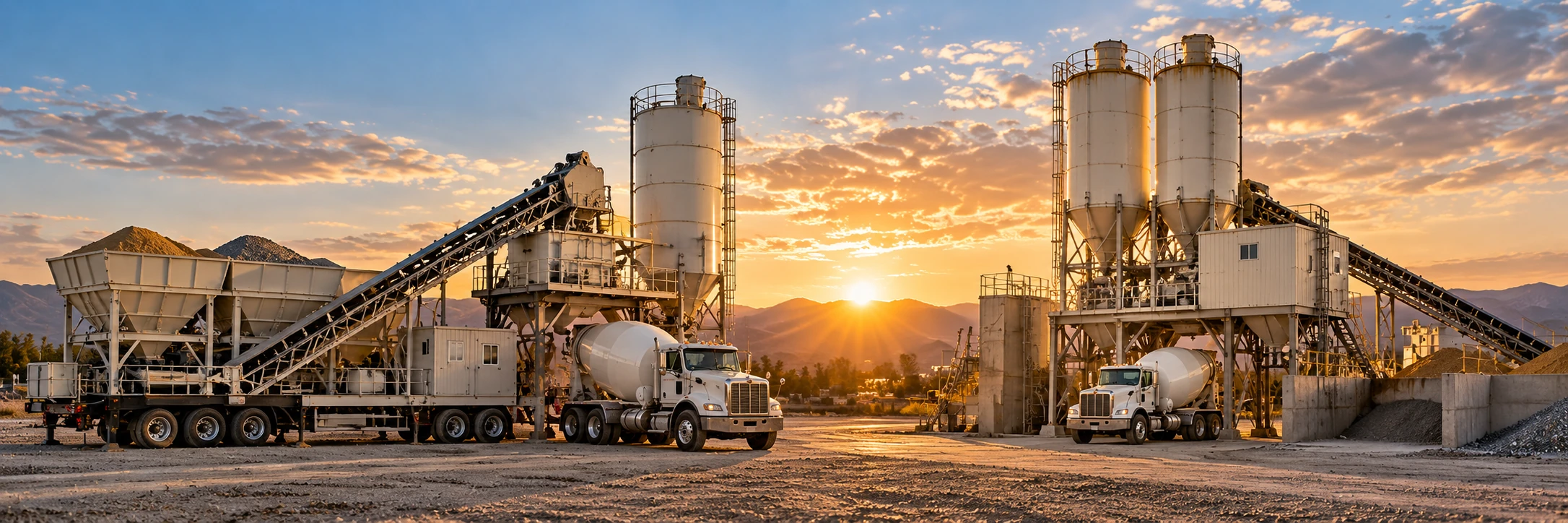
A mobile batch plant is designed around relocation. Depending on design, major components may be trailer-mounted, self-erecting or configured to reduce traditional foundation and crane requirements.
What is a stationary batch plant?
A stationary plant is intended for longer-term operation at a fixed location. It can make it easier to build around larger aggregate storage, multiple cementitious silos, permanent utilities, dust collection, central mixers and expanded truck staging.
The biggest decision factors
1. How often will the plant move?
If relocation is part of the business model, mobility has direct economic value. If the plant is expected to remain for many years, site-specific stationary design may matter more.
2. Required production rate
Evaluate sustained production, truck cycle time, mix designs, replenishment and likely bottlenecks rather than brochure maximums alone.
3. Aggregate storage
More mix designs generally mean more aggregate compartments and more material-handling complexity.
4. Cementitious storage
Count how many materials must remain available—cement, fly ash, slag or others—and whether auxiliary storage can be expanded.
5. Dry batch or central mix?
The mobility decision is separate from the mixing method. Choose the production method around the market, product and quality requirements.
6. Site preparation
Foundations, power, water, drainage, stockpiles, truck circulation, dust control, washout and maintenance space all influence total project effort.
7. Permitting and environmental controls
Mobility does not eliminate permitting. Air, dust, stormwater, zoning, noise and traffic requirements can still apply.
Portable vs. stationary: quick comparison
| Question | Portable plant | Stationary plant |
|---|---|---|
| Frequent relocation | Strong advantage | Usually weaker |
| Permanent long-term site | Can work | Often strongest fit |
| Fast deployment | Often better | Usually more site work |
| Maximum customization | More constrained | Usually greater |
| Large permanent storage | Possible | Often easier |
| Expansion flexibility | Design-dependent | Often stronger |
Don't buy portability you do not need
Trailer frames, hydraulic erection systems and folding structures are valuable if they help you earn money. If the plant never moves, those features may not be the highest-value investment.
How many moves in five years? Required sustained production? Aggregate materials? Cementitious materials? Dry or central mix? Existing utilities? Available site room? Likely future expansion?
When buying used
Confirm the actual configuration, bins, silos, controls, conveyors, mixer, dust collection, electrical system, missing components, structural condition and transportation requirements. Never assume everything visible in an older installation is included in the sale.