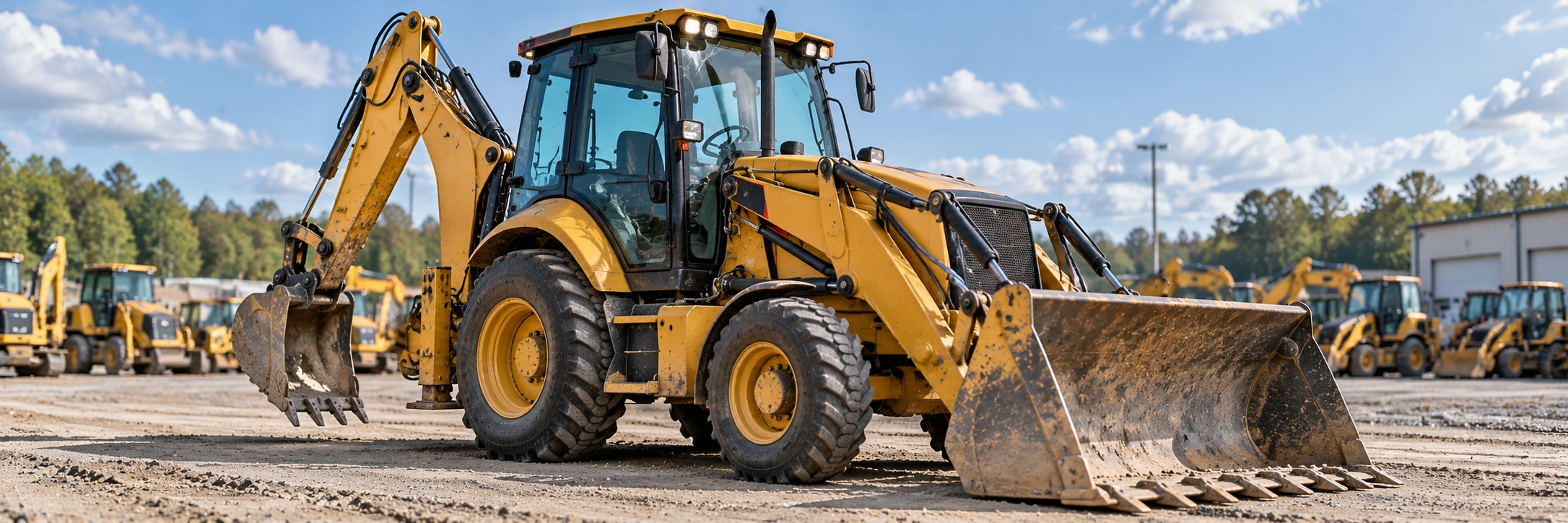
A used backhoe loader should be evaluated as two working ends, a drivetrain, hydraulics and a chassis—not by its hour meter alone. Verify the configuration and service history, inspect loader and digging linkages, operate hydraulics warm, test travel and brakes, then price likely repairs into the purchase decision.
What should buyers inspect before buying a used backhoe?
Inspect the loader linkage, boom and dipper, bucket joints, stabilizers, hydraulics, drivetrain, tires, engine and service records.
A good inspection should answer three questions: how hard the machine has worked, which systems have measurable wear, and whether the remaining condition fits the asking price. Manufacturer maintenance guidance and certified-used programs consistently emphasize structured walkarounds, fluid checks, operational tests and machine-history review.
1. Verify the exact backhoe configuration
Confirm the model, serial or PIN, indicated hours, four-wheel-drive configuration, transmission type, tire size, loader bucket, backhoe bucket, coupler, auxiliary hydraulics and whether the machine has an extendable dipper. Record every attachment that is actually included.
Ask for service records and major repair history. Pay particular attention to hydraulic work, transmission or axle repairs, boom or frame welding and replacement of high-wear pins and bushings.
2. Inspect the front loader linkage
Check the loader arms, crossmember, bucket, cutting edge, tilt links and all pivot points. Look for cracks, distortion, elongated pin bores, loose bushings and heavy weld repair. Raise and curl the loader repeatedly while watching for excessive movement at the pins.
Inspect lift and tilt cylinder rods for scoring and check seals, hoses and fittings for leakage.
3. Inspect the backhoe boom, dipper and bucket
Examine the boom, dipper or stick, bucket linkage, coupler and bucket teeth. Look closely at the boom foot, swing tower, cylinder mounts and high-stress weld areas. Excessive side play at the bucket or dipper can indicate pin and bushing wear that adds up across multiple joints.
If the machine has an extendable dipper, extend it fully and inspect the sliding surfaces, wear pads, hoses and extension cylinder.
4. Check swing system and stabilizers
Operate the backhoe left and right and watch for excessive movement at the swing tower. Deploy both stabilizers and inspect pads, beams, pins and cylinders. The stabilizers should move smoothly and hold the machine without obvious drift.
5. Test the hydraulics when the oil is warm
Cold hydraulic oil can mask some symptoms. Bring the machine to normal operating temperature, then cycle loader, backhoe, steering and auxiliary functions. Watch for slow response, chatter, weak combined functions, cylinder drift or unusual pump noise.
6. Evaluate drivetrain, axles and brakes
Drive the backhoe in a safe area through forward and reverse ranges. Test shuttle response, four-wheel drive where equipped, differential lock, steering and service brakes. Inspect axle housings and hubs for leakage. Listen for abnormal noise during tight turns and direction changes.
7. Inspect tires, rims and alignment clues
Check all tires for cuts, weathering, uneven wear and mismatched sizes or tread patterns. Rear tires can be a substantial replacement item. Look at rims and wheel hardware, and note whether the machine tracks straight.
8. Check engine, cooling system and cab
Start the machine cold when possible. Watch for smoke, warning lights, hard starting and unusual noise. Inspect radiator and coolers for debris or damage and check for active fluid leaks. In the cab, verify gauges, controls, seat belt, lights, horn, HVAC and any backup alarm or camera equipment.
9. Perform a realistic functional test
Operate both ends of the machine, not just the loader. Dig, lift, swing, stabilize and travel in a controlled area if the seller and site permit. A machine that idles smoothly can behave very differently once several hydraulic functions are working under load.
Used backhoe inspection scorecard
| Area | Strong | Investigate | Concern |
|---|---|---|---|
| Loader linkage / bucket | □ | □ | □ |
| Boom / dipper / bucket linkage | □ | □ | □ |
| Swing tower / stabilizers | □ | □ | □ |
| Hydraulics | □ | □ | □ |
| Transmission / axles / brakes | □ | □ | □ |
| Tires / wheels | □ | □ | □ |
| Engine / cooling / records | □ | □ | □ |
The takeaway
A used backhoe should be valued as a complete system. A strong engine does not offset a loose digging end, weak stabilizers or a worn shuttle transmission. Inspect both working ends, verify the drivetrain and use repair estimates to compare machines on total condition.
Related BigEquipCo guides: Backhoe vs. Excavator and Heavy Equipment Total Cost of Ownership.
Make the inspection conditions clear
Ask the seller to identify the machine configuration, attachments and any known limitations before the inspection. If practical, review records and inspect the backhoe both cold and after it has reached operating temperature. Check for abnormal noise, leaks, uneven movement and warning indicators, and compare the meter reading with available records. Test each control safely in an open area with a qualified operator. A short visual review cannot establish the condition of every internal component; use an independent mechanic or equipment inspector when the purchase risk warrants it, and document any repair estimate before agreeing on price.